Just a short update (for those of you not following me on facebook, twitter or googleplus) to say that some of my camera trap photos from last spring were published in UK newspapers today. Some corny captions and a couple inaccuracies, but the photos look good! Links:
http://www.telegraph.co.uk/news/picturegalleries/picturesoftheday/8744049/Pictures-of-the-day-6-September-2011.html?image=3
http://www.thesun.co.uk/sol/homepage/news/3797667/Peek-ape-boo.html
http://www.metro.co.uk/news/874665-curious-safari-animals-fascinated-by-camera-traps-set-up-to-study-them
Showing posts with label camera traps. Show all posts
Showing posts with label camera traps. Show all posts
Wednesday, September 7, 2011

Monday, August 29, 2011
Camera Trap Fun
On Saturday I picked up my first round of camera trap photos. I haven't gone through them all yet (already behind), but I've already got a few good ones:


Typical curious tommy photo

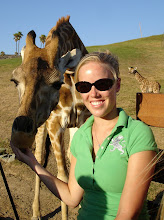
The first time I've gotten a giraffe face close up. Usually I just get knees.

A successful photobomb by Jennifer
While moving traps around, I disturbed this frog that had made its home in one of the steel casings. Safe place, I guess, until I come and mess it up.

I also caught this hyena taking a photo of himself:

Unfortunately, he is not as good as Jennifer at taking photos of himself, and the camera only caught the very side of him. Still, it was cool to see an animal interacting with the camera first hand.
I'll be posting more photos here of course, but check out this link for more camera trap photos and this link for more regular photos between blog posts.

I also caught this hyena taking a photo of himself:

Unfortunately, he is not as good as Jennifer at taking photos of himself, and the camera only caught the very side of him. Still, it was cool to see an animal interacting with the camera first hand.
I'll be posting more photos here of course, but check out this link for more camera trap photos and this link for more regular photos between blog posts.
Saturday, April 2, 2011
Camera trap shenanigans
While a lot of species seem to be curious about the strange boxes on posts that have appeared on the Ol Pejeta landscape recently, some are more curious than others. This has led to some amusing surprises when I check the traps and go through the photos.
First, a tiny frog has taken up residence in one of the steel camera casings. He seems right at home and not at all bothered when I open the case and remove the camera to check it once a week.


Several times I've returned to check cameras to find the poles less than upright in the ground (yes, even more cock-eyed than they were when I put them in) and loose in their holes. Once this turned out to be due to a cow that apparently grazed straight over the trap, producing this angle:

Another time the trap had caught the attention of one or more young baboons which turned it into a play platform:

Hyenas have been curious about the traps since day one, so I was not surprised to find that a trap I had placed near a den was partially knocked over. More surprising were the toothmarks in the steel casing and brass padlock. Solid metal doesn't seem like a very inviting chew toy.
Once I noticed that an otherwise intact trap was curiously dirty. This was the work of these patas monkeys:


In the last week I have also caught some less meddlesome but very exciting species, including my first lion:
and an aardvark!
Getting an aardvark photo has always been my unofficial motive for camera trapping in the first place (the official motive being my research). They are very nocturnal and spend a lot of their time underground in the holes they dig to search for termites. They are very difficult to see so I was excited when that photo came up on my screen.
First, a tiny frog has taken up residence in one of the steel camera casings. He seems right at home and not at all bothered when I open the case and remove the camera to check it once a week.


Several times I've returned to check cameras to find the poles less than upright in the ground (yes, even more cock-eyed than they were when I put them in) and loose in their holes. Once this turned out to be due to a cow that apparently grazed straight over the trap, producing this angle:

Another time the trap had caught the attention of one or more young baboons which turned it into a play platform:


Hyenas have been curious about the traps since day one, so I was not surprised to find that a trap I had placed near a den was partially knocked over. More surprising were the toothmarks in the steel casing and brass padlock. Solid metal doesn't seem like a very inviting chew toy.
Once I noticed that an otherwise intact trap was curiously dirty. This was the work of these patas monkeys:


In the last week I have also caught some less meddlesome but very exciting species, including my first lion:

and an aardvark!

Getting an aardvark photo has always been my unofficial motive for camera trapping in the first place (the official motive being my research). They are very nocturnal and spend a lot of their time underground in the holes they dig to search for termites. They are very difficult to see so I was excited when that photo came up on my screen.
Tuesday, March 15, 2011
Camera Trap Results
I retrieved the photos from the camera traps after the first three days of trapping, and I have to say the results are encouraging.
First, only one camera of the eight was too crooked to capture what it needed to. It was tilted such that it was aimed too high, which I discovered when I downloaded a lot of photos of animals' backs and this photo:

Very entertaining, but I really need to be able to photograph animals without them having to stand on their tippy toes. I returned to this camera and lowered it, so hopefully that helps.
Second, I got a wide variety of species: 11 in only three days at 8 cameras. I of course got tommies as well as loads of zebra,
 impala,
 and warthog.
Rarer captures included giraffe,
 Grant's gazelles,
 and spotted hyenas (which thankfully did not try to snack on the cameras - a concern even despite the steel casing).
I also got one shot each of cheetah,
 white-tailed mongoose,
 and a super cool striped hyena, which tends to be a very elusive creature.

In addition to all the wild species, I got more than my share of photos of cattle and sheep. Even some curious cattle herders made an appearance:


Despite all the attention, no cameras were knocked over, mauled, stolen, or otherwise tampered with, which is very encouraging. Tomorrow I will put the remaining two traps out, move a couple around, and hopefully collect some more cool photos to share with you!
First, only one camera of the eight was too crooked to capture what it needed to. It was tilted such that it was aimed too high, which I discovered when I downloaded a lot of photos of animals' backs and this photo:

Very entertaining, but I really need to be able to photograph animals without them having to stand on their tippy toes. I returned to this camera and lowered it, so hopefully that helps.
Second, I got a wide variety of species: 11 in only three days at 8 cameras. I of course got tommies as well as loads of zebra,
 impala,
 and warthog.
Rarer captures included giraffe,
 Grant's gazelles,
 and spotted hyenas (which thankfully did not try to snack on the cameras - a concern even despite the steel casing).
I also got one shot each of cheetah,
 white-tailed mongoose,
 and a super cool striped hyena, which tends to be a very elusive creature.
In addition to all the wild species, I got more than my share of photos of cattle and sheep. Even some curious cattle herders made an appearance:


Despite all the attention, no cameras were knocked over, mauled, stolen, or otherwise tampered with, which is very encouraging. Tomorrow I will put the remaining two traps out, move a couple around, and hopefully collect some more cool photos to share with you!
Friday, March 11, 2011
Smile for the Camera!
 Yesterday I put eight of my ten camera traps up. The camera traps are intended to give me an idea of the relative activity levels of different predator species in the habitats used by my tommies. As I said in an earlier post, mother tommies’ behavior should vary according to the predator assembly they are dealing with: if there are lots of large predators mothers should prioritize their own safety, but if there are many small predators mothers might spend more time and energy protecting their offspring.
The camera traps are Scoutguard SG550s ($200.00 retail if you want to put one up in your back yard). They are triggered by heat and movement. I have them set so that when they are triggered they take two photos in rapid succession. Then they reset and cannot be triggered for 30 seconds. Hopefully these settings will strike the right balance so that I am getting good photos of my predators without filling up the memory cards when a herd of zebras or cows decides to camp out around it. We’ll see.
Putting the traps up was hard work. I had the steel casings equipped with hardware so that I could mount them on steel poles that I would hammer into the ground. Problem: the ground is hard and I have the arm strength of an infant. The hammering was probably pretty comical. The poles also tended to go slanted if I stopped steadying them with my left hand, which was inevitable because my right arm was spent after about three and a half swings so I always ended up switching to a two-handed pounding approach. I imagine I looked a lot like some primitive and mentally-impaired primate, only less adept:

Blairopithecus hard at work
Most of the poles ended up pretty cock-eyed, but still vaguely oriented to an area where animals might walk.

I think the angle will give the photos an artsy feel
The four that I saw today were still upright also, so that’s a good sign.
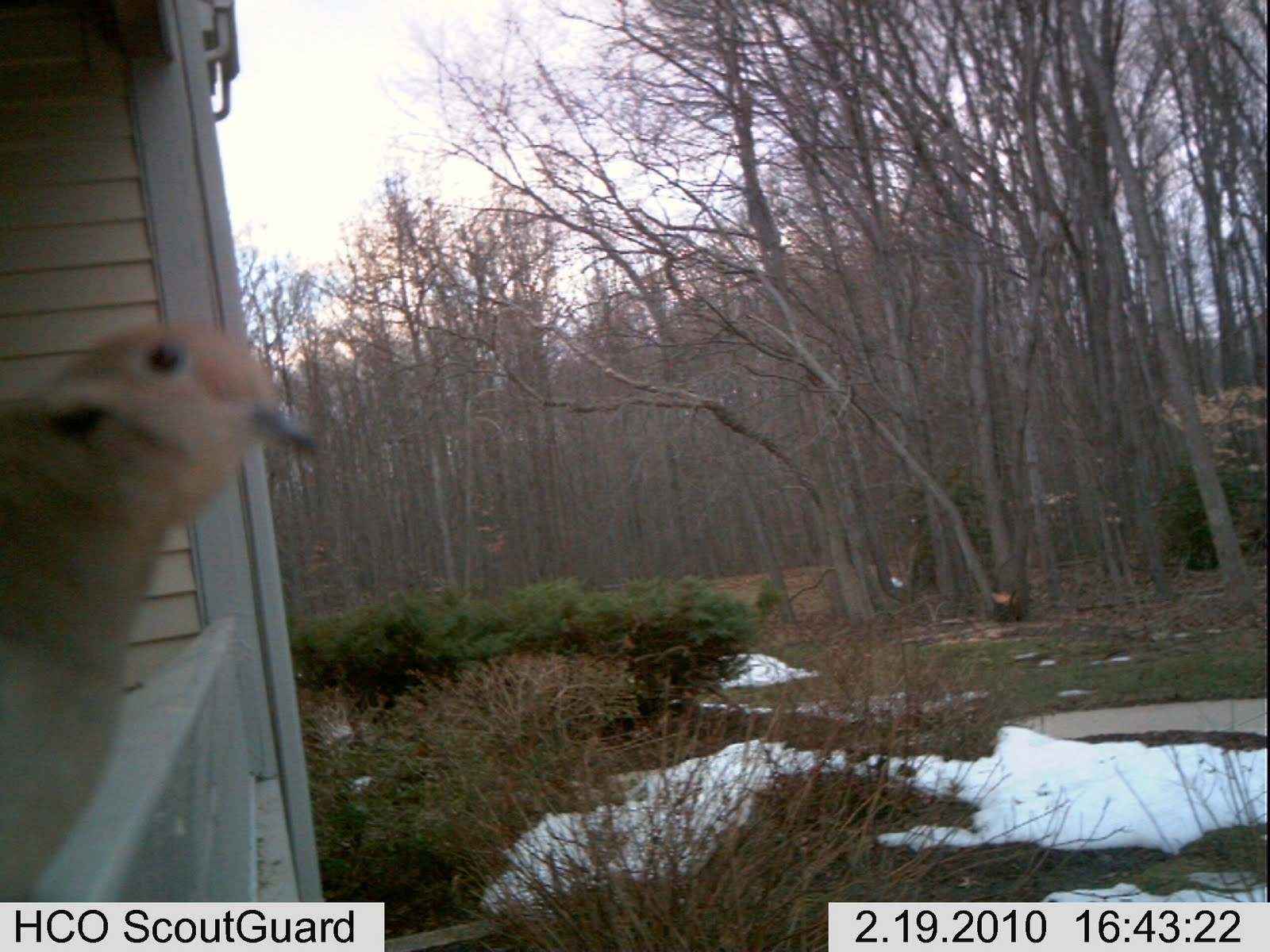
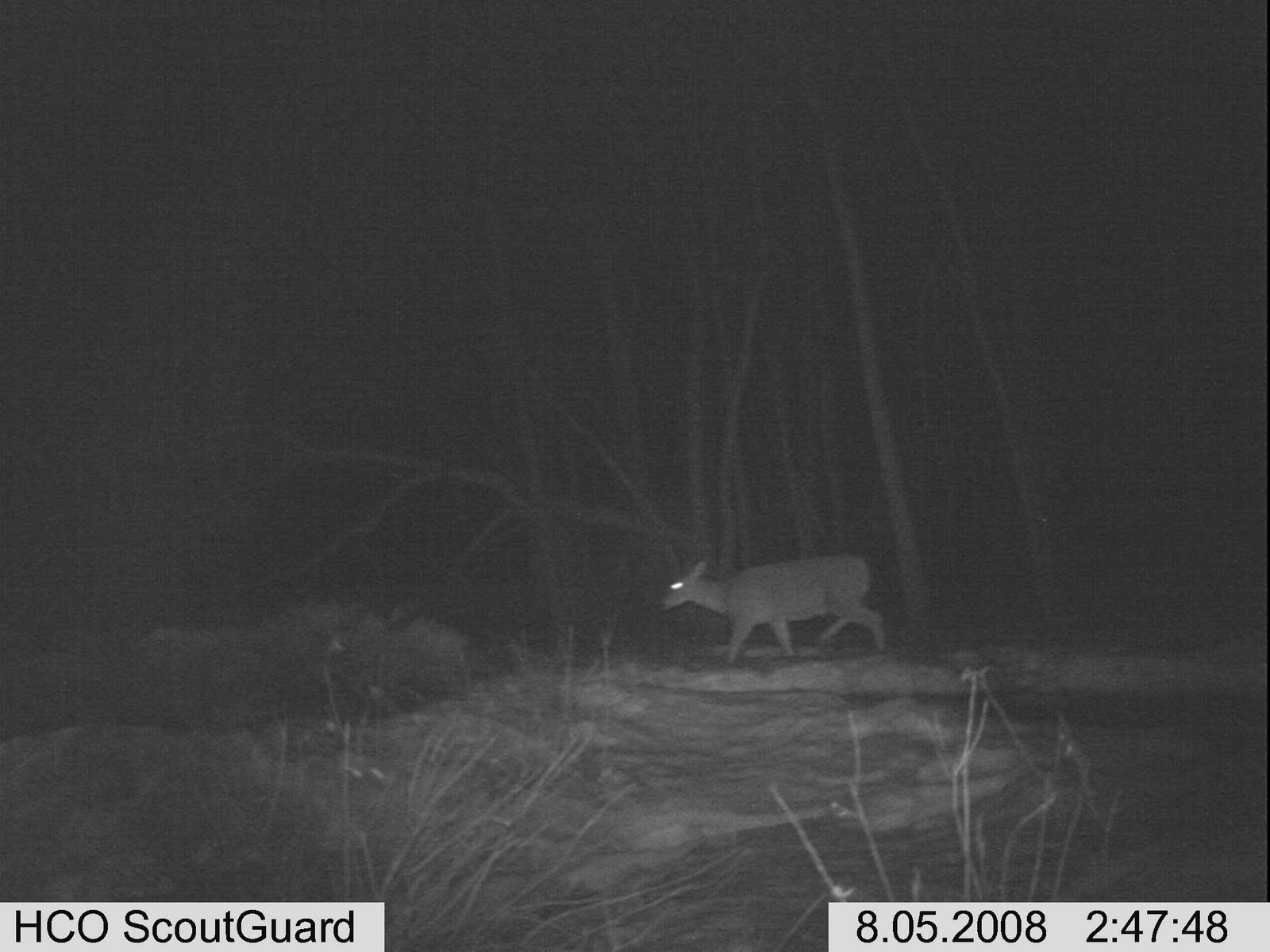
Before I left I tested the cameras in the office and in my back yard. I leave you with a couple photos from the tests. Hopefully by my next post I’ll have some more exotic photos to show off. Come on, aardvark!

Monday, February 14, 2011
9 Days
I have nine days until I return to Kenya for another 3-month stint. Preparations are going well, but I still have the requisite nerves about my departure. It helps a lot that this is more or less old hat by now and that I am familiar with my field site and many of my methods. That consolation only goes so far when faced with a three-month absence from home though!
I have a couple new project components that I will describe in more detail once I get to the field and start blogging in earnest. For now my main difficulty is that I have acquired 10 camera traps, each requiring a heavy steel case, multiple batteries, battery chargers & assorted other accessories. Total weight of this new equipment is a whopping 40 lbs. I have a 2x70 lb-bag luggage allotment on Delta (thank you Silver Medallion) in which to pack that equipment and just about everything else I'll need for three months. We'll see how this goes!
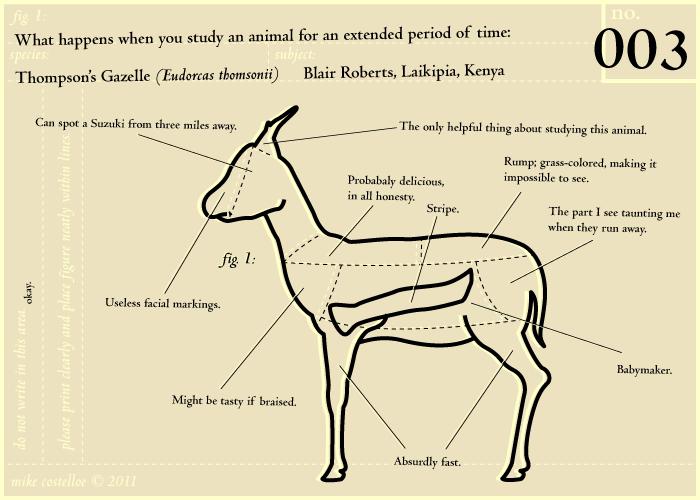
To celebrate my return to the blog and imminent return to the field, I present you with the following diagram of a Thomson's gazelle as seen after a long field trip. Image is courtesy of the immensely clever and charming Mike Costelloe. See more of his work at www.mikecostelloe.com.

I have a couple new project components that I will describe in more detail once I get to the field and start blogging in earnest. For now my main difficulty is that I have acquired 10 camera traps, each requiring a heavy steel case, multiple batteries, battery chargers & assorted other accessories. Total weight of this new equipment is a whopping 40 lbs. I have a 2x70 lb-bag luggage allotment on Delta (thank you Silver Medallion) in which to pack that equipment and just about everything else I'll need for three months. We'll see how this goes!
To celebrate my return to the blog and imminent return to the field, I present you with the following diagram of a Thomson's gazelle as seen after a long field trip. Image is courtesy of the immensely clever and charming Mike Costelloe. See more of his work at www.mikecostelloe.com.

Subscribe to:
Posts (Atom)